
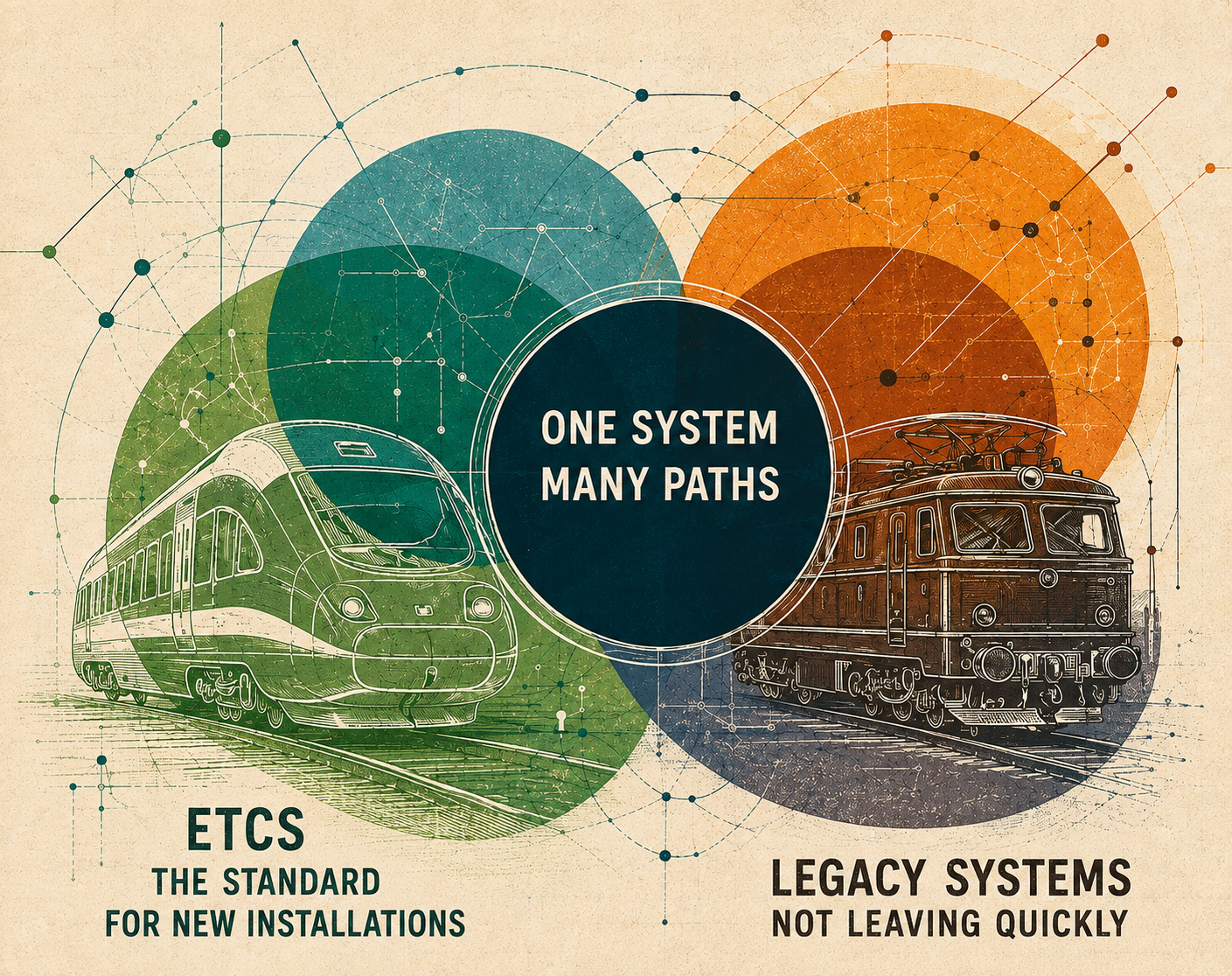
ETCS is a well established solution in European countries and the standard for new installations. The systems it replaces, however, are not leaving quickly.
Commission Regulation (EU) 2016/919 required every member state to prepare a National Implementation Plan describing its long-term strategy for railway infrastructure development, along with decommissioning dates for legacy systems. Read side by side, these plans show how differently countries approach the same goal.
Croatia planned its upgrade between 2018 and 2032. Because GSM-R infrastructure supporting mobile railway communication was missing, ETCS Level 1 was prioritized, and it will serve as a backup system even after GSM-R and ETCS Level 2 are implemented.
Poland does not intend to remove its national system SHP for the next 20 years, while planning ETCS coverage of 6,736 km by 2030 and up to 8,233 km by 2050.
Austria, with PZB deployed extensively across its network, plans continued operation and limited investment in that equipment beyond 2030. Its LZB transition allows no overlapping equipment at all — every LZB part must be dismantled entirely before ETCS can be implemented.
The strategy for infrastructure upgrades clearly differs per country. Years of investment in infrastructure, fleet and management systems make the move to a unified solution a lengthy exercise. Vehicles intended to operate across lines are usually constrained to carry legacy systems in addition to ETCS, which raises installation costs and extends project timelines.